I watched the first few seasons of the Sopranos before I went to university but I stopped I think at the beginning of season four because of the distractions of a busy metropolis, and I even stopped watching television altogether for a few years. Earlier this year, me and my partner decided to watch the whole series together from the beginning – for better or worse, over the last six or seven months we have sat around discussing the show. I say six or seven months – neither of us could quite cope with binging the series, one because the torrent of sexism, racism and violence makes it emotionally draining, but also the quality of the writing makes every scene loaded with meaning, and watching it on autopilot is like wasting a carefully prepared meal. I am a lot older than when I first started watching – I now have a PhD in the history and philosophy of science and I have spent at least six years of my life researching the ways psychiatric diagnoses were reached in the past. I then of course paid particular attention to the carefully placed editions of the DSM on Dr. Melfi’s bookshelf, the statements on psychological disorders and mafia culture, and the depictions of the psychiatric clinic – these have all interested me more than perhaps they would have first time around (also sorry to my partner here for all the poorly formulated ramblings on Neo-Kraepelinian diagnosis and psychoanalysis that I subjected you to).
At times I have wondered whether the show is actually an extended critique of the way that psychiatry is practiced in the USA, using Italian-American organised crime as its vehicle. The more I think about it, the more complexly subtle it is in how it represents psychiatric illnesses and treatments, but at the same time, just as Jennifer Melfi does not provide the easy answers that Tony Soprano is looking for during their sessions, the show refuses to provide blunt statements and instead seems to spin out a continual problematic that introduces new difficulties before previous ones have been resolved. The comparisons between AJ and Corrado’s treatments in psychiatric wards to the expensive therapy sessions Tony enjoys, the provision of private psychiatric treatment and even the possibility that Pauli would be diagnosed with anti-social behaviour disorder had he even bothered to see a psychiatrist, all these are introduced without much attempts to resolve them before moving quickly on.
This sort of reminds me of one of Tony’s more insightful moments a psychedelic experience during a jolly to Las Vegas – after describing what seems to be a connection he made to the ineffable, and how the trip questioned his means to an end existence to tell him that what we see and feel is not all there is, he makes this strange comparison between mothers and bus drivers: he corrects himself to say they are actually the bus, a vehicle that drops you off and then moves on to carry on its journey. The problem is we keep on trying to get back on them when instead we should just accept that they have gone and let them go. Tony is not being a wacky faux-intellectual here – he introduced idiosyncratic remarks by saying that they are going to sound really stupid, and once he finishes with a final flourish that expresses frustration at an inability to fully grasp a thought before it eludes him, Melfi pauses and seems genuinely impressed at Tony’s insights.
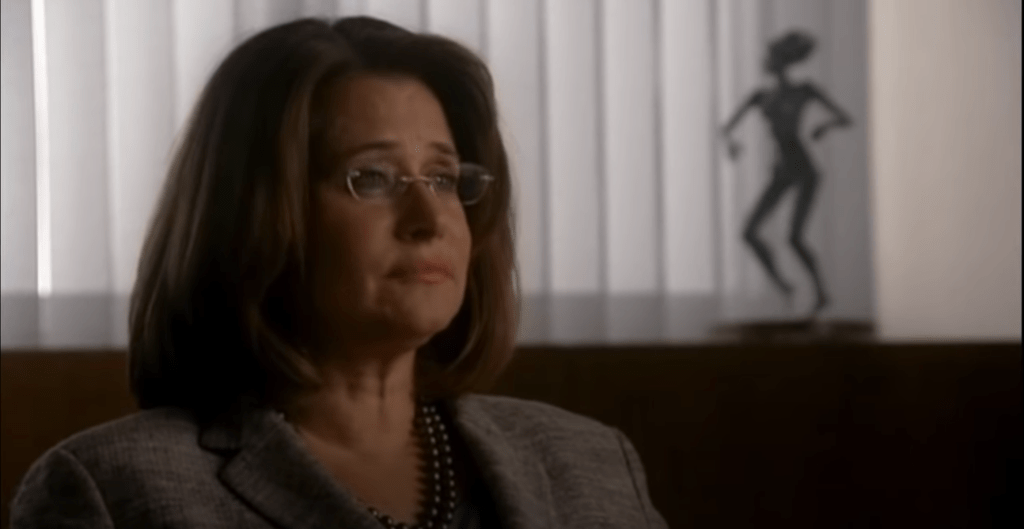
What is going on here? Fans of the show know the dreadful relationship Tony had with his mother that defined much of his misery and eventually led to their estrangement before her death. His suffering is caused by a repression that manifests itself in violent fluctuations between conservative uprightness that preaches on the virtues of the traditional family, and the extreme hedonism that in reality alienates him from his wife and children. He seems to express here a twilight of awareness of the sub-conscious forces that are driving his self destruction, but perhaps there is something else going on as well – the show could be saying that psychoanalysis is futile and the time that Tony and Melfi have spent together has been a waste of time, or even worse, may have helped him to perfect the manipulation he uses in his criminal life (more on this in a future post)? Or it could be saying that psychoanalysis is a never-ending process that although leading us to dissatisfaction and turmoil because we will never fully understand and control these forces, the process at least allows us to approach an awareness of these to help us change our relationships to ourselves and others? This could account for why Tony’s peyotl induced remarks resonated with Melfi – over the course of the series, she has expressed doubts at times, either to Tony, her own psychiatrist or her partner, about the worth of the treatment. Perhaps this strange encounter with Tony has clarified some of her thoughts on her efforts to treat a person many psychiatrists would have dismissed as a sociopath. Interestingly and as alluded to earlier in this paragraph, this apparent meeting of minds happened shortly before Tony and Melfi’s relationship soured for good at the suggestion that as a psychopath, Tony may have used the sessions to hone his criminal skills, but this is a subject that deserves a longer discussion so I will save it for another post.
 Kevin Matthew Jones