
I am a historian of science and medicine who specialises in nineteenth and twentieth century history. My research looks at the development of concepts of psychopathology and their use in mental health statistics between 1850 and 1950. I am interested in the role that medical categories and psychiatric classification have played in the development of public health during this period, and how they have shaped psychological treatment and medical diagnosis. The work I developed into my recent monograph was based on my doctoral research, that presented a case study developed by the Medico-Psychological Association of the United Kingdom, the precursor to the Royal College of Psychiatrists. The classification, The Table of the Forms of Insanity, was a list of psychopathologies that had been developed by the Association for around a century.
My work charts the development of psychological classification from the beginning of the 19th century, using the work of Philippe Pinel as a starting point, before moving on to look at the categories developed by the authorities in charge of compiling asylum medical statistics on diagnosis, the Lunacy Commission, which was established by Lunacy legislation passed in 1845. From there I chart the slow development of statistics on diagnosis alongside the story of the statistical Table of the Forms, as it was revised three times during the period between 1845 and 1948. The Table was designed to standardise diagnosis to improve statistics, and this use of the Table caused debates over classification that would stand years and in one instance, the to-ing and fro-ing took decades. The Table of the Forms would be forgotten by history as the WHO’s International Classification of Diseases (ICD) came to be used in NHS health statistics on diagnosis shortly after the Second World War.
A sideline to my research is an interest in the relationships between clinical knowledge and popular media. My most recent article has explored the reasons behind the increased number of portrayals of psychiatry in Hollywood cinema during the mid twentieth century. It provides a reading of the 1959 film Suddenly, Last Summer to explore the representation of mental health diagnosis in visual media. The reading questions the idea that we can understand terms of diagnosis as stable historical categories and the common view that knowledge of mental health disorders originate in the clinic and then diffuse outwards into popular culture. My work aims to map the complex relationships between popular representations of diagnosis and expert knowledge, and provide reflections on the ways cinema shapes clinical diagnosis. I am also in the process of finalising an article that analyses how Victorian alienists read depictions of popular literature, drawing upon reviews of fiction that appeared in medical journals during the second half of the nineteenth century.
My future research has two distinct but interrelated avenues. Firstly, I seek to provide a deeper understanding of the ways research into insanity and its different forms was conducted by those affiliated with the Galton Laboratory at UCL. My recent monograph touches upon this area by looking at the published research of Karl Pearson on mental health statistics, and I seek to expand on this research by drawing upon Pearson’s personal papers held in UCL special collection, specifically the investigations into phthisis and tuberculosis that he attempted to link to data on insanity. Secondly, I seek to understand the ways that population science during the C20th has handled mental health, and establish links to birth rate research.
I have also published on the history of the British Psychological Society in the United Kingdom and have co-edited a volume on the integrated history and philosophy of science.
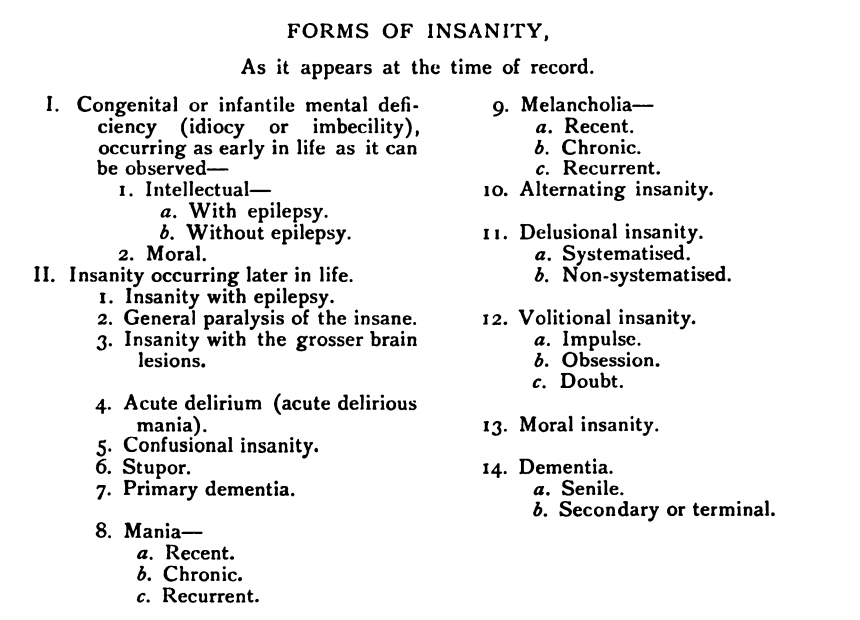 Classification of the Forms of Insanity, Medico-Psychological Association, 1906.
 Kevin Matthew Jones